
Blog
How to Choose a Jewelry Appraiser: What GIA, ISA, and USPAP Credentials Mean
Choosing a jewelry appraiser means telling apart gemological training from appraisal credentials, and knowing which one actually qualifies someone to value your piece. This guide explains what GIA, ISA, and USPAP each certify, and the red flags that signal a conflict of interest.
Anyone can hang a sign that says "jewelry appraiser." Few people asking for an appraisal know how to tell a credentialed professional from someone reciting retail prices. The distinction matters because the credential behind the signature determines whether your report holds up for insurance, an IRS filing, a divorce settlement, or a disputed estate.
This guide breaks down what the most commonly cited credentials, GIA, ISA, and USPAP, actually certify, and what they don't. It also covers the independence standard every appraiser should meet and the red flags that should send you looking elsewhere. If you're evaluating candidates for a jewelry appraisal, start here before you book anyone.
Why Gemology Training and Appraisal Training Are Not the Same Thing
A qualified jewelry appraiser needs two separate kinds of competence: the gemological knowledge to identify and grade the stones and metals in front of them, and the formal appraisal training to develop and report a defensible value. Having one does not automatically mean someone has the other. A person can be an excellent gemologist and a poor appraiser, or the reverse.
This split confuses a lot of people because the marketing often blurs it. "GIA certified appraiser" is a phrase you'll see on business cards and storefronts, and it implies something that isn't quite accurate.
What a GIA Graduate Gemologist Credential Actually Certifies
A GIA Graduate Gemologist (GG) diploma certifies that someone completed a structured program in identifying and grading diamonds and colored stones, including detecting treatments, synthetics, and imitations. It does not certify appraisal competence. GIA itself states that it does not offer appraisal courses and does not certify its graduates as appraisers.
That distinction matters in practice. A Graduate Gemologist might know the precise identification and quality of a gemstone, but determining a specific monetary value requires separate training in valuation methodology, market research, and report writing. Years of bench experience selling jewelry are not a substitute for that training either.
None of this makes a GG diploma worthless to an appraisal. It's valuable, often essential, as the gemological foundation beneath the appraisal work. The problem is treating it as the whole credential instead of half of it.
Pro tip: If someone describes themselves as a "GIA certified appraiser," ask them to name the actual credential. If the answer is a GIA Graduate Gemologist diploma, follow up by asking what separate appraisal training and experience they hold.
What ISA Membership and USPAP Training Certify
The International Society of Appraisers (ISA) addresses the other half of the equation: appraisal theory, methodology, ethics, and report-writing standards. ISA's credentialing requirements include completion of its core appraisal coursework, documented market-related experience, and the 15-hour Uniform Standards of Professional Appraisal Practice (USPAP) course, with a required update course on a two-year cycle thereafter.
USPAP itself, published by The Appraisal Foundation, is the generally recognized ethical and performance framework for appraisers in the United States. It governs how an appraiser identifies the intended use of a report, defines the type of value being reported (replacement cost, fair market value, liquidation value), states the effective date, and discloses the scope of work and any limiting conditions. A jewelry appraisal that skips these disclosures is not a complete report no matter how accurate the stone grading is.
It's worth being precise about what USPAP compliance proves and what it doesn't. It proves the report follows a recognized structure and ethical standard. It does not prove the appraiser can identify a treated stone, determine whether a diamond is lab grown, or correctly value a rare period piece. That expertise still comes from gemological training and specialized market experience.
The American Society of Appraisers (ASA) runs a parallel path through its Gems & Jewelry discipline, which combines gemological proficiency requirements with appraisal-specific education and examination. The National Association of Jewelry Appraisers (NAJA) offers its own tiered membership levels built around appraisal methodology and ethics rather than gemology alone. Both exist for the same reason ISA does: appraisal competence is its own discipline, separate from the ability to grade a stone.
Gemology-Only vs. Appraisal-Specific Credentials
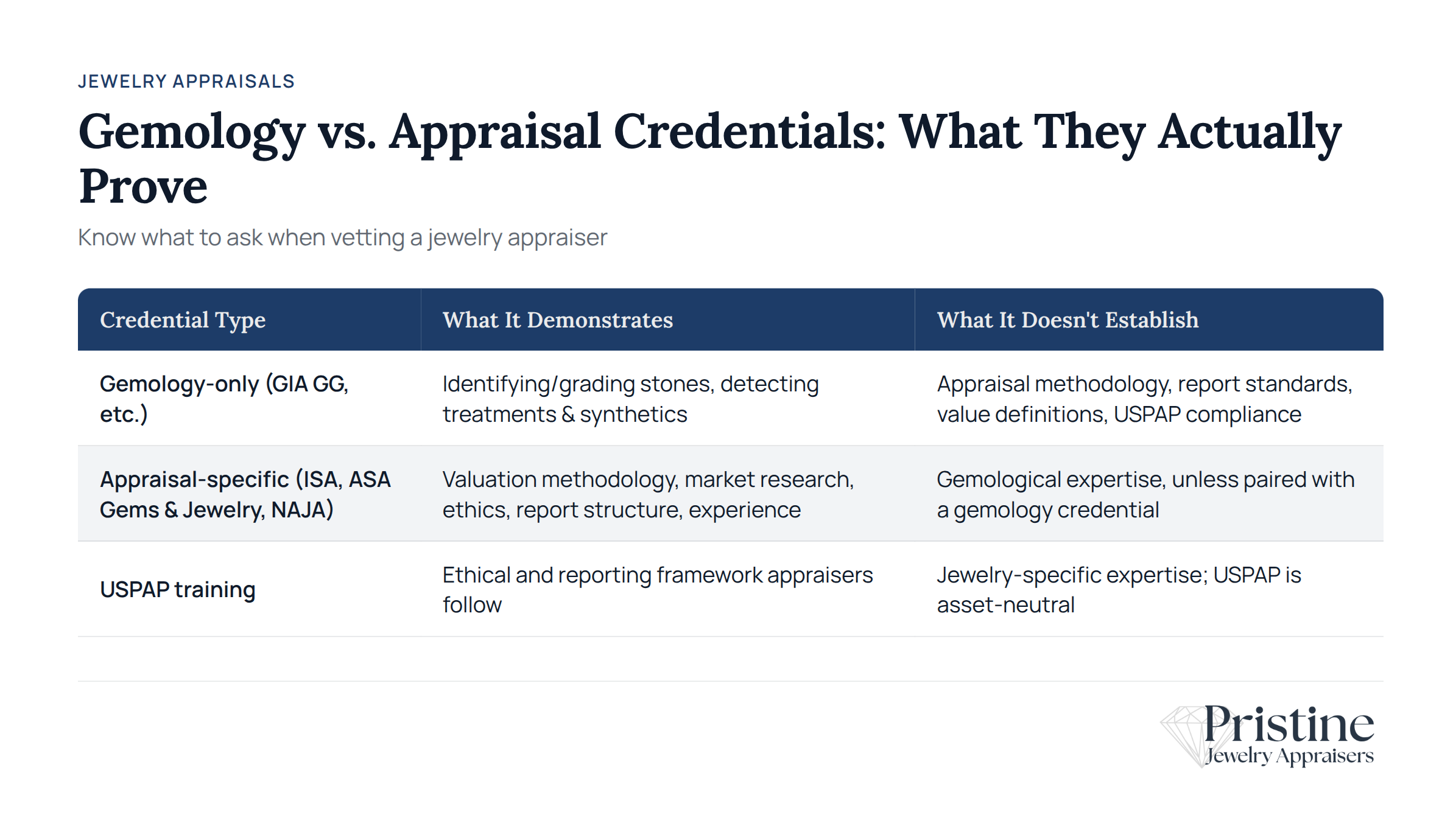
The table below separates what each type of credential actually demonstrates, so you can ask the right follow-up questions when you're vetting a candidate.
| Credential type | What it demonstrates | What it doesn't establish |
|---|---|---|
| Gemology-only (GIA GG and similar) | Technical ability to identify and grade stones, detect treatments and synthetics | Appraisal methodology, report-writing standards, value definitions, USPAP compliance |
| Appraisal-specific (ISA, ASA Gems & Jewelry, NAJA) | Valuation methodology, market research, ethics, report structure, documented appraisal experience | Independent proof of gemological expertise unless paired with a gemology credential |
| USPAP training | Familiarity with the ethical and reporting framework appraisers are expected to follow | Jewelry-specific expertise of any kind; USPAP is asset-neutral |
Why the Strongest Jewelry Appraisers Combine Both Tracks
The most defensible profile for a jewelry appraisal combines specialized gemological training, a formal appraisal-specific designation, current USPAP status, and market experience in the exact category of jewelry involved. An appraiser who handles contemporary diamond engagement rings every day may not be the right choice for a signed Art Deco brooch or an antique colored-stone collection. ISA's designation requirements specifically call for documented market experience in a declared specialty, not just general membership.
This combination becomes especially important when the appraisal has a legal or tax purpose. If you're donating jewelry and claiming a deduction, the IRS has its own definition of a qualified appraiser under its qualified appraisal rules for noncash charitable contributions, separate from any private credentialing body's standards. Our guide on what makes a jewelry donation appraisal qualify for IRS Form 8283 walks through those requirements in detail. The same logic applies to estate and gift tax filings, where the appraiser needs to understand the specific valuation premise the return requires.
The Independence Principle: Why Your Appraiser Shouldn't Want to Buy Your Jewelry
A disinterested appraiser is one of the clearest signals of a trustworthy appraisal. The appraiser's opinion of value should never be influenced by whether they stand to profit from the number they write down. This is a cornerstone of USPAP's ethics requirements, and it's also common sense: an appraiser who buys jewelry has a direct financial incentive to undervalue it, and an appraiser who sells jewelry has an incentive to inflate a replacement value that makes their own merchandise look like a bargain by comparison.
The IRS applies this principle formally. Its qualified appraiser rules generally disqualify the donor, a related party, the recipient organization, or anyone whose fee depends on the appraised value, under its qualified appraisal framework. The same independence standard is good practice even when a tax filing isn't involved.
Key takeaway: The appraiser's fee should be fixed and based on the scope of the assignment, never a percentage of the value they conclude. A percentage-based fee is itself a conflict of interest, regardless of how good the appraiser's credentials look on paper.
Red Flags That Signal a Conflict of Interest
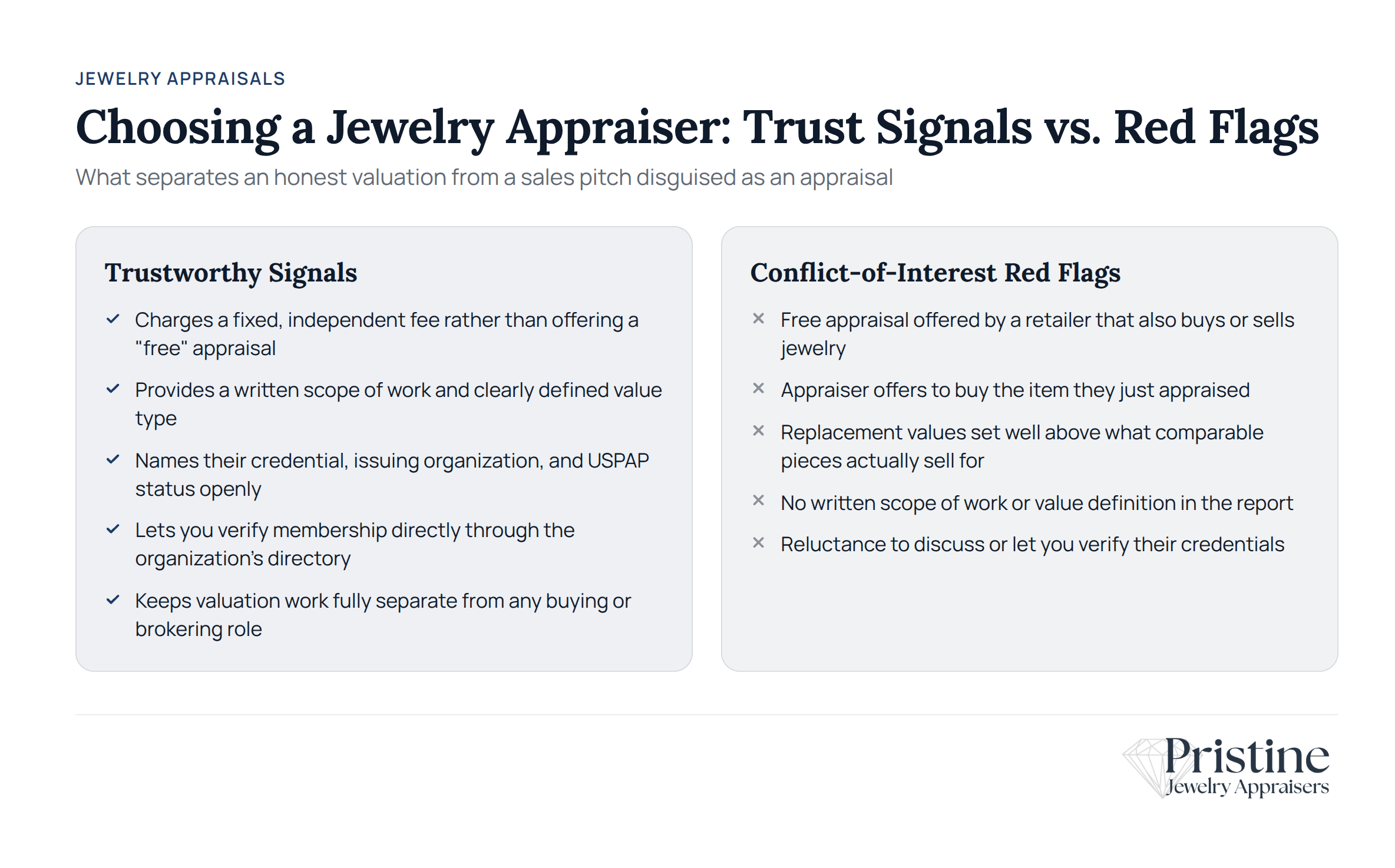
A few patterns show up again and again when an appraisal is being used as a sales tool rather than an honest valuation.
- Free appraisals from a retailer that also buys or sells jewelry: A "free appraisal" offered by the same counter that's trying to sell you insurance, a trade-in, or a new setting has an obvious incentive problem, even if the person behind the counter is genuinely skilled.
- An appraiser who offers to buy the item they just appraised: This is the independence principle violated outright. A legitimate appraiser separates the valuation role from any buying or brokering role entirely.
- Replacement values that run well above what comparable pieces actually sell for: Inflated replacement-cost figures are sometimes used to justify a bigger sale on a "replacement" item, or simply to make the appraisal look more impressive than it is.
- No written scope of work or value definition: A report that doesn't state what type of value is being reported, or why, leaves you unable to tell whether the number even answers the question you asked.
- Reluctance to discuss credentials or let you verify them: A legitimate appraiser will name their designation, issuing organization, and USPAP status without hesitation, and most organizations maintain a directory where membership can be checked directly.
How to Verify Credentials Before You Hire
Before booking an appraisal, ask for specifics rather than accepting a general claim of expertise.
- Ask for the exact designation and issuing organization. "Certified appraiser" means nothing on its own; a verifiable ISA, ASA, or NAJA designation does.
- Ask what gemological training backs it up. A GIA Graduate Gemologist diploma or equivalent is the standard most appraisal organizations look for alongside their own designation.
- Confirm current USPAP status. Ask when the appraiser completed the initial 15-hour course and the most recent two-year update.
- Match experience to your specific item. An appraiser skilled with modern diamonds may not be the right fit for antique, signed, or colored-stone pieces.
- Confirm the fee is fixed, not tied to value. The engagement should be quoted upfront based on the scope of the assignment, not as a percentage of the appraised result.
Many readers are also surprised that the credential mix above is only part of what drives a quote. Scope, documentation quality, and intended use matter just as much; our breakdown of what determines the cost of a professional jewelry appraisal covers those factors in detail.
Choosing with Confidence
The short version: look for an appraiser who pairs gemological training with a formal appraisal credential, carries current USPAP status, has experience with your specific category of jewelry, and has no financial stake in the number they conclude. Our team holds credentials across these tracks and prepares reports built for the specific purpose you need, whether that's insurance, estate planning, or a charitable donation. Request an appraisal when you're ready to have your jewelry evaluated by a qualified, independent appraiser.
This article is provided for general informational purposes only and does not constitute legal, tax, or financial advice. Readers should consult a qualified attorney or CPA regarding their specific circumstances.