
Blog
Is Form 8283 an Appraisal? What Jewelry Donors Need to Know About the Difference
Form 8283 is an appraisal summary, not an appraisal itself. This guide breaks down what the IRS actually requires inside a qualified jewelry appraisal, and the dollar thresholds that decide when you need one.
Published
If you're donating a jewelry item worth more than $5,000, someone has probably told you "just fill out Form 8283" as if that solves the paperwork problem. It doesn't. Form 8283 and a qualified appraisal are two different documents with two different jobs, and confusing them is one of the fastest ways to lose a charitable deduction. This guide walks through exactly what each document is, what the IRS requires inside a real qualified appraisal, and the dollar thresholds that determine what you actually need before you file.
What Is Form 8283, Exactly?
Form 8283 is the IRS tax form you attach to your return to report noncash charitable contributions. It is generally required once your total noncash donations for the year exceed $500, and Section B applies to any single item, or group of similar items, claimed at more than $5,000. The form captures basic facts: a description of the donated property, the date of the gift, the name of the donee organization, and signatures from the appraiser and the charity.
What Form 8283 does not do is establish the value of your jewelry. It's a reporting mechanism, not a valuation. The IRS Form 8283 instructions are blunt about this distinction, and it's worth reading in the IRS's own words.
Our team prepares USPAP-compliant jewelry appraisals specifically built to support Form 8283 filings, and we've seen how often donors assume the form alone covers them. A related guide on our site, what makes a jewelry donation appraisal qualify for Form 8283, covers the qualification rules in more depth if you want the fuller picture before you donate.
The IRS Says It Plainly: Form 8283 Is Not an Appraisal
The IRS instructions for Form 8283 state the distinction directly: "Form 8283 is an appraisal summary. It is not an appraisal." That single sentence resolves a lot of confusion, and it's the reason the question "is Form 8283 an appraisal" has a clean, definitive no.
A qualified appraisal is a separate, standalone valuation report. It is prepared by a qualified appraiser, it exists independently of the tax form, and it has to meet its own set of content and timing requirements under the tax code before the IRS will accept the claimed value behind it. Form 8283 transmits information about that appraisal to the IRS; it doesn't replace it, and simply completing the form does not cure the absence of an actual appraisal document.
Watch out: Donors sometimes have a jeweler write a one-paragraph letter stating a value, then attach that letter to Form 8283 and assume they're covered. A letter is not a qualified appraisal unless it contains the specific elements described below and was prepared by someone who meets the IRS's qualified appraiser requirements.
What a Qualified Appraisal Must Actually Contain
Under Treasury Regulation 1.170A-17 and the standards described in IRS Publication 561, a qualified appraisal has to include specific elements, not a general sense of worth. The appraisal document must contain the following:
- A description of the property in sufficient detail that someone unfamiliar with the item could identify it, including its physical condition at the time of the gift
- The date of the contribution, or the expected date if the gift hasn't yet been completed
- The terms of any agreement or understanding relating to the use, sale, or other disposition of the property
- The appraiser's qualifications, including background, experience, education, and professional association membership
- A statement that the appraisal was prepared for income tax purposes
- The appraised fair market value as of the date of contribution
- The valuation method used to reach that value, such as the sales-comparison, cost, or income approach
- The specific basis for the valuation, meaning the reasoning and evidence behind the number, not just the conclusion
- The date (or dates) on which the property was valued, and the date the report itself was completed
This is why a jewelry store receipt, an insurance rider, or a verbal estimate from a dealer doesn't hold up as a qualified appraisal. None of those documents walk through valuation methodology or establish the appraiser's qualifications the way the regulations require.
Pro tip: Ask any appraiser you're considering to show you a sample report before you commit. A compliant jewelry appraisal reads like a professional document with distinct sections, not a one-page price quote.
Jewelry-Specific Content the IRS Expects
Jewelry carries its own detail requirements because value hinges on characteristics a general description can't capture. IRS guidance on appraising jewelry calls for the report to address:
- The style of the piece and the setting of the gem, since mounting and craftsmanship affect value independent of the stone itself
- Stone coloring, cut, and weight, stated precisely rather than approximated
- Brilliance and the presence of any flaws or inclusions that affect clarity
- Supporting documentation such as GIA certificates and color photographs of the item
A credentialed appraiser working under ISA, ASA, or AAA standards, with GIA gemological training where relevant, builds these details into the report as a matter of course. This is also where plenty of informal valuations fall short: a jeweler's quick note might mention "diamond ring, 1.5 carats" without ever addressing cut grade, color grade, or clarity, all of which a qualified appraisal has to document.
Form 8283 vs the Qualified Appraisal at a Glance
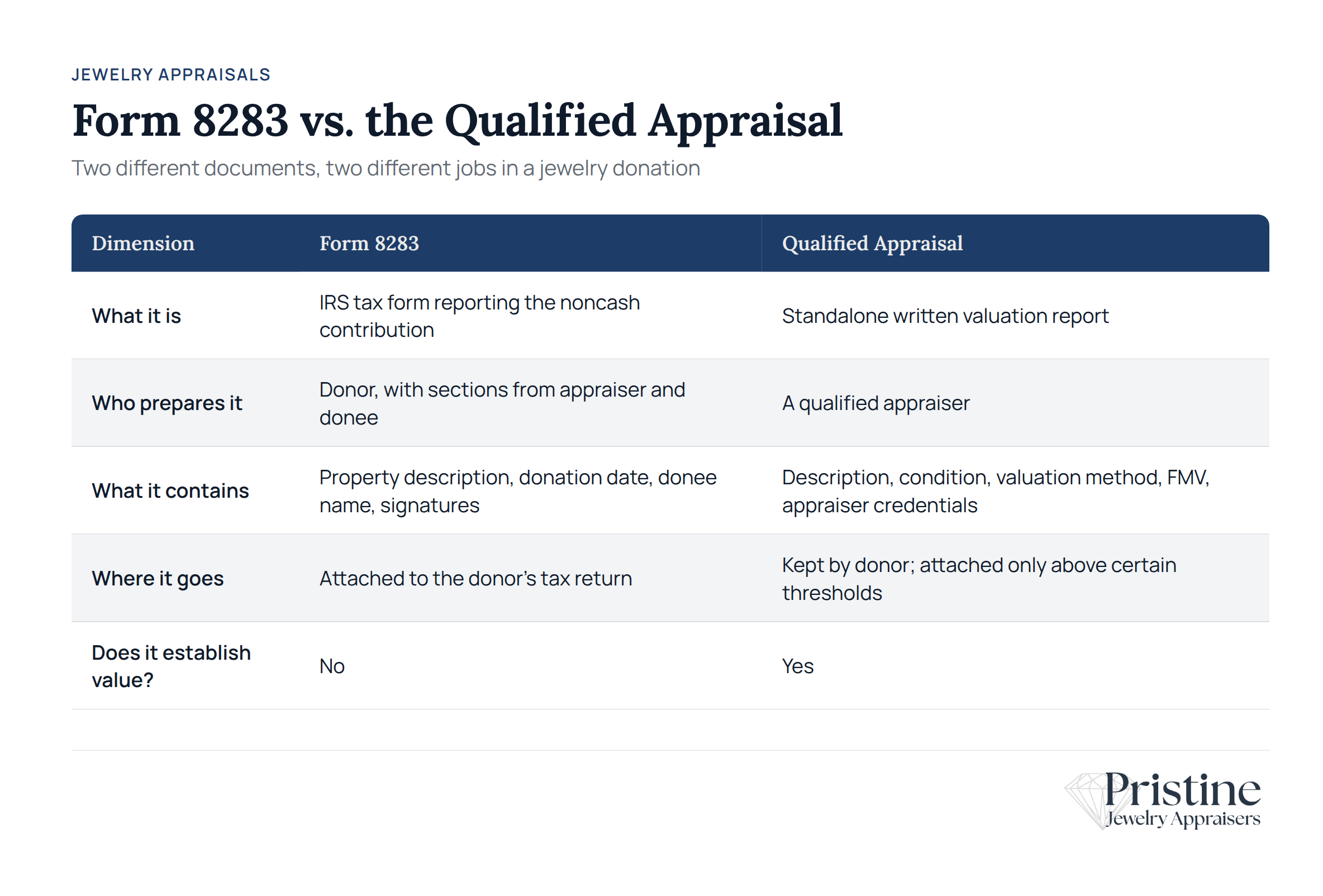
Seeing the two documents side by side makes the distinction concrete. The table below summarizes what each one is, who prepares it, and where it ends up.
| Form 8283 | Qualified Appraisal | |
|---|---|---|
| What it is | An IRS tax form reporting the noncash contribution | A standalone written valuation report |
| Who prepares it | The donor, with sections completed by the appraiser and donee | A qualified appraiser |
| What it contains | Property description, donation date, donee name, signatures | Detailed description, condition, valuation method, FMV, appraiser credentials |
| Where it goes | Attached to the donor's tax return | Kept by the donor; attached to the return only above certain thresholds |
| Does it establish value? | No | Yes |
The Dollar Thresholds That Determine What You Need
Three separate dollar amounts govern how this process works, and mixing them up is one of the most common mistakes donors make.
- $5,000: Once a claimed deduction for an item, or group of similar items, exceeds this amount, you generally must complete Section B of Form 8283 and obtain a qualified appraisal to support the value.
- $20,000: For art donations claimed at $20,000 or more, the IRS generally expects a complete, signed copy of the appraisal attached to the return. Jewelry doesn't automatically trigger this specific rule the way art does, but donors claiming high-value pieces should keep the full appraisal ready to produce if asked.
- $500,000: Above this figure, the qualified appraisal itself generally must be attached to the federal income tax return, not just kept on file. Below that threshold, you typically retain the appraisal in your records rather than submit it with the return.
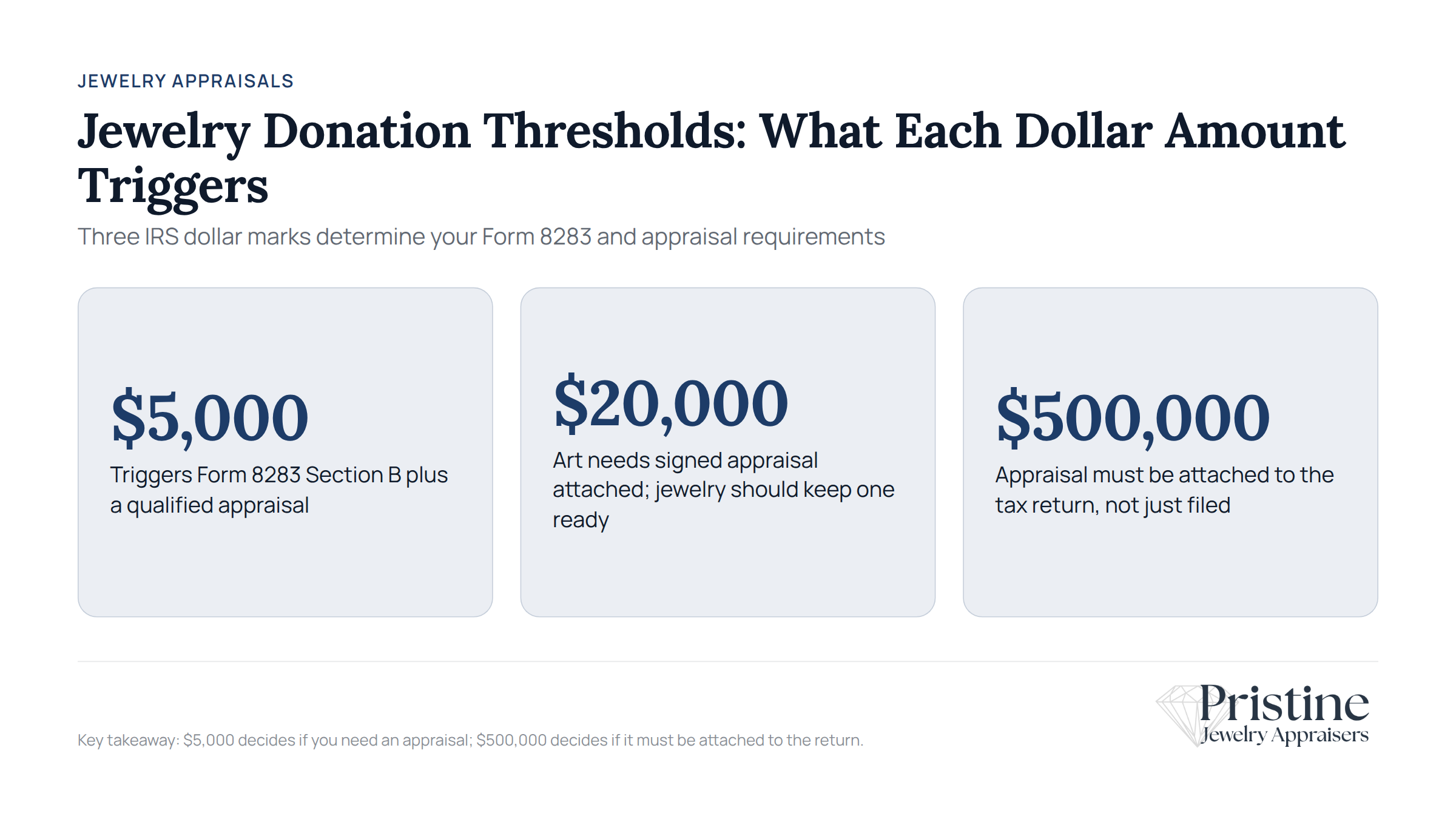
Key takeaway: The $500 and $5,000 thresholds decide whether you need Form 8283 and a qualified appraisal at all. The $500,000 threshold decides whether that appraisal has to physically travel with your tax return.
When You Must Receive the Appraisal
Timing matters as much as content. The IRS Form 8283 instructions require that you receive the qualified appraisal no later than the due date, including extensions, of the return on which you first claim the deduction. If the deduction is instead first claimed on an amended return, the appraisal must be in hand before that amended return is filed.
An appraisal obtained after the fact, scrambled together once the IRS starts asking questions, generally won't satisfy this requirement even if the valuation itself is accurate. The appraisal also generally can't be dated more than 60 days before the contribution. Donors planning a significant jewelry gift should have the appraisal commissioned well ahead of tax season, not as a last-minute addition.
Protect Your Deduction With the Right Document From the Start
Form 8283 and a qualified appraisal solve different problems. The form tells the IRS what you're claiming; the appraisal proves the number is defensible. Skipping the appraisal, or treating an informal valuation as if it qualifies, puts the entire deduction at risk regardless of how carefully you fill out the form itself.
Our appraisers prepare USPAP-compliant jewelry appraisals built around the IRS's specific content and timing requirements, from stone-by-stone detail to the valuation methodology section a qualified appraisal has to include. If you're planning a jewelry donation, request an appraisal early enough to meet your filing deadline with a report that actually holds up.
This article is provided for general informational purposes only and does not constitute legal, tax, or financial advice. Readers should consult a qualified attorney or CPA regarding their specific circumstances.