
Blog
What Determines the Cost of a Professional Jewelry Appraisal
Jewelry appraisal cost is set by scope, not by what your ring or necklace is worth. This guide breaks down exactly which factors, from item count to gemstone testing to report depth, determine your fixed appraisal fee.
Jewelry appraisal cost depends on what needs to be examined and documented, not on what the jewelry is worth. A single engagement ring, a loose diamond pulled from a safe deposit box, and a 40-piece estate collection each require a different amount of appraiser time, so they carry different fees. This guide breaks down the specific factors behind jewelry appraisal pricing: how many items are involved, how complex the gemstone testing is, and how deep the written report needs to be.
How Jewelry Appraisal Fees Are Structured: Per-Item vs. Collection Pricing
Jewelry appraisal fees scale with the number of items and the intended use of the report, not with the dollar value of the jewelry itself. A single ring appraised for insurance scheduling costs less than a full estate collection appraised for tax purposes, because the estate assignment requires far more appraiser hours.
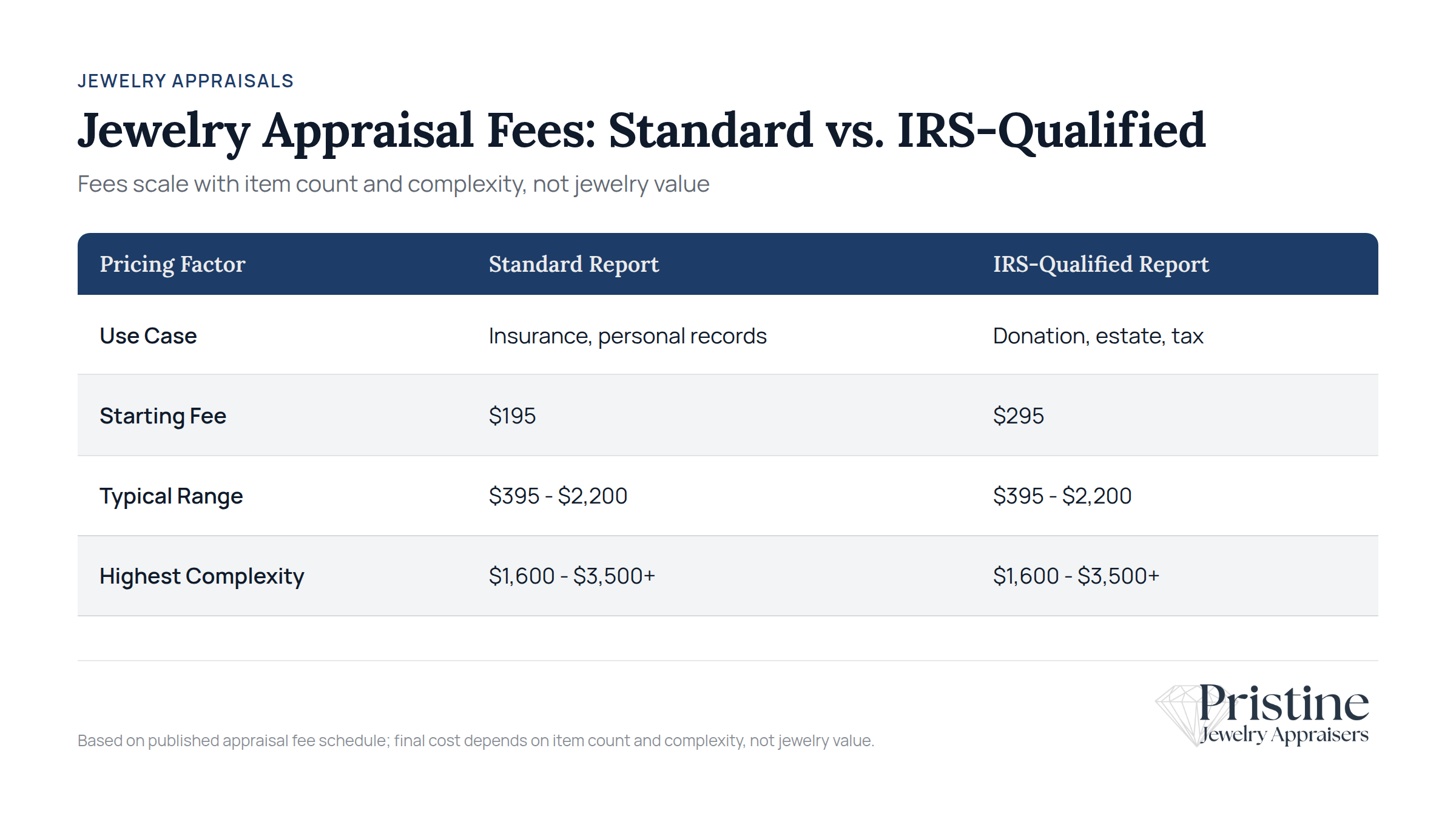
Our published fees for jewelry appraisals work like this:
| Assignment Tier | Starting Fee | Typical Range | Highest Complexity |
|---|---|---|---|
| Standard report (insurance, personal records) | $195 | $395 - $2,200 | $1,600 - $3,500+ |
| Advanced, IRS-qualified report (donation, estate, tax) | $295 | $395 - $2,200 | $1,600 - $3,500+ |
A single, modern piece with a clear gem report typically lands near the starting fee. A collection with multiple pieces, mixed metals, and several distinct gemstone types moves into the typical range simply because each item needs its own identification, measurement, and market research. The same pricing structure applies whether the piece in question is an engagement ring, a loose diamond, a designer watch, or a set of estate silverware; the number and complexity of the items drive the number, not the category label on the item.
Why Gemstone Testing Complexity Raises the Fee
The more testing a gemstone requires, the more the appraisal costs, because testing time is billable time. A loose, unmounted stone is usually the fastest item to test since the appraiser has full access to weigh it, measure it, and examine it from every angle.
Mounted stones take longer. An appraiser working with a stone set in a ring or bracelet often cannot remove it, so identification and measurement have to be done through the setting, which takes more skill and more time than examining a loose stone. Multi-stone pieces compound this: a tennis bracelet or an eternity band with 30 small diamonds still requires the appraiser to account for each stone, even when many of them are calibrated to the same approximate size.
Antique and designer pieces add a research layer on top of the gemological work. Identifying that a bracelet came from a particular design house or a particular period requires provenance research and comparison to auction and dealer records for that maker or era, work that a general jewelry identification does not require. Identifying a stone's cut, clarity, and carat weight is a gemological skill on its own; translating that identification into a defensible dollar opinion for a specific market is a separate, appraisal-specific skill, and it's the second skill that the fee is paying for.
Watch out: A gemologist's identification certificate is not an appraisal. It tells you what the stone is; it does not tell you what a comparable stone sells for in a relevant market, which is the analysis an appraisal report has to contain.
Why the Fee Is Never Tied to Your Jewelry's Value
A properly credentialed jewelry appraiser cannot charge a percentage of the item's appraised value, and this rule shapes how every legitimate fee is built. Guidance published by the American Society of Appraisers states plainly that no properly credentialed appraiser will charge based on a percentage of the appraised value unless mandated by law, and that fees should instead be set by the hour, by the piece, or by the project.
The American Society of Appraisers' own code of ethics goes further, treating compensation that is contingent on the value conclusion as unethical outside of rare judicial exceptions, as outlined in the ASA's principles of appraisal practice and code of ethics. Documentation from the American Gem Society describes the same standard from the practitioner's side: charges are commonly based on the time involved or the number of pieces being appraised, according to the American Gem Society's guidance on professional appraisal services.
This matters for scope, not just ethics. A borrower's credit history, an item's market value, or a client's financial situation never enters the fee calculation. What does enter the calculation is the number of items, the complexity of the testing they require, the completeness of any existing documentation, and the intended use of the report. Our appraisers hold credentials with organizations such as the American Society of Appraisers (ASA), the International Society of Appraisers (ISA), the Appraisers Association of America (AAA), and the Gemological Institute of America (GIA), and every report we prepare follows this same scope-based fee structure.
Verbal Consultation vs. a Written USPAP-Compliant Report
A verbal consultation costs less than a written report because it skips the documentation work that makes a report defensible. When an appraiser gives you a spoken opinion of value with no paperwork, they still have to identify and grade the item, but they don't have to produce photographs, a methodology section, comparable sales data, or a signed certification.
A written report suitable for insurance, an IRS filing, a divorce settlement, or litigation is a different assignment entirely. Reports prepared in accordance with USPAP, the standard published by The Appraisal Foundation, require the appraiser to disclose the methodology used, document each item with photographs, cite comparable market data, and state the intended use of the appraisal. Building that record takes hours a verbal opinion does not, and the fee reflects it.
Example: Appraising a single diamond ring verbally, with no written documentation, might take an appraiser 20 minutes. Producing a full written report on that same ring, complete with photographs, gemological findings, and comparable sales, might take two to three hours once research and report writing are included. The fee difference between the two isn't arbitrary; it tracks the actual hours involved.
Pro tip: If your intended use is insurance, an IRS filing, or a legal proceeding, ask for a written report up front. A verbal opinion generally will not satisfy any of those purposes, and paying for one first only to need a written report later means paying for the same item twice.
How We Scope and Quote Your Appraisal
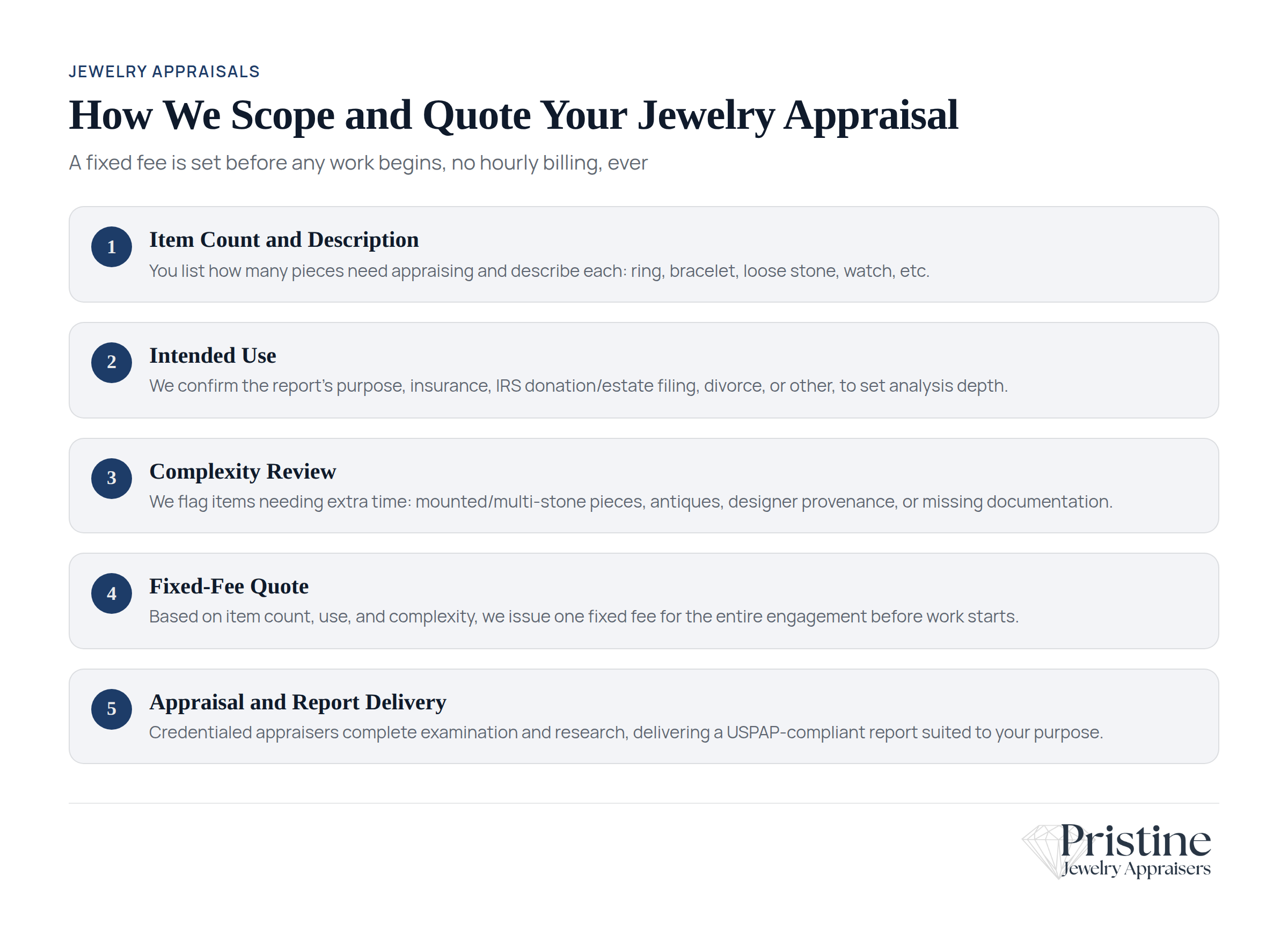
Every jewelry appraisal we prepare is quoted as a fixed fee before work begins. We never bill by the hour, and the number you're quoted is the number you pay, regardless of how the appraised value comes out.
Here is how that quote gets built:
- Item Count and Description
- You tell us how many pieces need appraising and give a basic description of each: ring, bracelet, loose stone, watch, and so on.
- Intended Use
- We confirm whether the report needs to support insurance scheduling, an IRS-qualified donation or estate filing, a divorce proceeding, or another purpose, since this determines the depth of analysis required.
- Complexity Review
- We flag items that need extra time: mounted or multi-stone pieces, antique or designer pieces requiring provenance research, or items with incomplete documentation.
- Fixed-Fee Quote
- Based on the item count, intended use, and complexity, we provide a single fixed fee for the entire engagement before we begin work.
- Appraisal and Report Delivery
- Our credentialed appraisers complete the examination, research, and written report, then deliver a USPAP-compliant document suited to your stated purpose.
If you're ready to move forward, you can request a jewelry appraisal and get a fixed-fee quote scoped to your specific pieces before any work begins.
The Bottom Line on Jewelry Appraisal Pricing
Jewelry appraisal cost comes down to scope: how many items, how much testing each one needs, and how detailed the final report has to be. It never comes down to what the jewelry is worth or what your financial situation looks like. Understanding these fee drivers ahead of time means no surprises when your quote arrives, and it means you're paying for exactly the analysis your ring, collection, or estate actually requires.
This article is provided for general informational purposes only and does not constitute legal, tax, or financial advice. Readers should consult a qualified attorney or CPA regarding their specific circumstances.