
Blog
What Makes a Jewelry Donation Appraisal Qualify for IRS Form 8283
A jewelry donation claimed above $5,000 needs a qualified appraisal that satisfies specific IRS content and timing rules before Form 8283 can be filed. This guide breaks down what the appraisal must document, who is barred from writing it, and why the appraiser's fee structure matters to your deduction.
Donating a diamond ring, an estate necklace, or a collection of fine jewelry to a qualifying charity can produce a meaningful tax deduction, but only if the paperwork behind it holds up. Once the claimed value crosses $5,000, the IRS does not accept a jeweler's price tag, an insurance estimate, or a donor's own guess. It requires a qualified appraisal, prepared by a qualified appraiser, attached to a properly completed Form 8283. Our jewelry appraisal service exists largely because donors learn this rule after the fact, often close to a filing deadline.
When Does a Jewelry Donation Require a Qualified Appraisal?
A jewelry donation triggers the qualified appraisal requirement once the claimed deduction for the item, or a group of similar items given to the same organization, exceeds $5,000. Below that threshold, a receipt and reasonable documentation of value are generally enough. Above it, IRS Publication 561 requires a formal appraisal, and the donor must complete Section B of Form 8283.
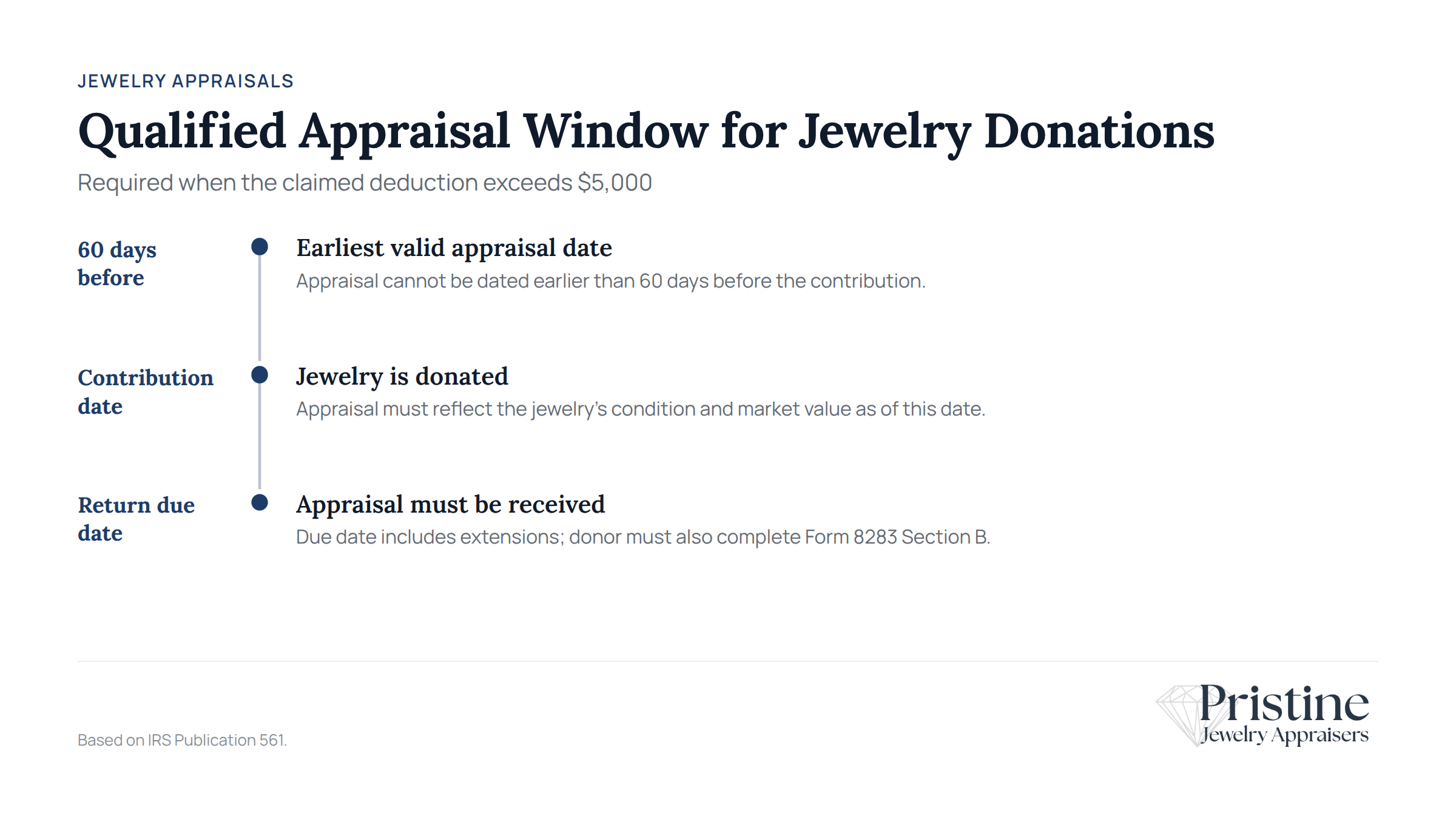
The appraisal also has to fall within a specific window. It must be dated no earlier than 60 days before the date the jewelry is actually donated, and it must be received by the donor no later than the due date, including extensions, of the tax return on which the deduction is first claimed. An appraisal written too far in advance, or one obtained after the return has already been filed, does not qualify, regardless of how thorough it is.
This timing rule surprises a lot of donors who assume an old appraisal (say, one done for insurance purposes two years earlier) will satisfy the IRS. It will not. The valuation has to reflect the jewelry's condition and the market as of the contribution date, not a snapshot from years before. For estate jewelry moving through a similar reporting process, our guide to jewelry appraisal rules for IRS estate and gift tax returns covers the parallel timing requirements that apply outside the charitable context.
What Must a Qualified Jewelry Appraisal Actually Contain?
A qualified appraisal for jewelry has to say enough that someone who has never seen the piece could understand exactly what was donated and how the value was reached. Because gems and jewelry are treated as a specialized category, IRS Publication 561 calls for a level of detail that goes well beyond a general description.
At minimum, a compliant jewelry appraisal should document:
- Style and construction: the type of piece, its era or period, the setting style, and how the stone is mounted.
- Gemstone characteristics: coloring, weight (in carats), cut, brilliance, and any flaws or inclusions.
- Grading documentation: GIA certificates where available, along with color photographs of the item.
- Market relevance: whether the style is currently in fashion, since this affects resale demand and therefore fair market value.
- Metal content and maker marks: precious-metal purity, designer or manufacturer identification, and any hallmarks.
- Condition: wear, damage, prior repairs, or alterations that affect value.
- Valuation method and conclusion: the approach used to reach fair market value, supporting market evidence, and the appraiser's signed, dated conclusion.
One detail that trips up donors: sentimental value, family history, or emotional attachment plays no role in fair market value. A ring that has been in a family for three generations is valued the same way a stranger's identical ring would be, based on what a willing buyer would pay a willing seller with reasonable knowledge of the relevant facts. The only exception is celebrity or notable provenance, which can genuinely increase value if it is documented.
Watch out: An insurance replacement estimate is not a qualified appraisal, even when it is detailed. Replacement cost reflects retail pricing to replace an item, not the fair market value standard the IRS applies to charitable deductions.
Who Is Disqualified From Being Your Jewelry's Appraiser?
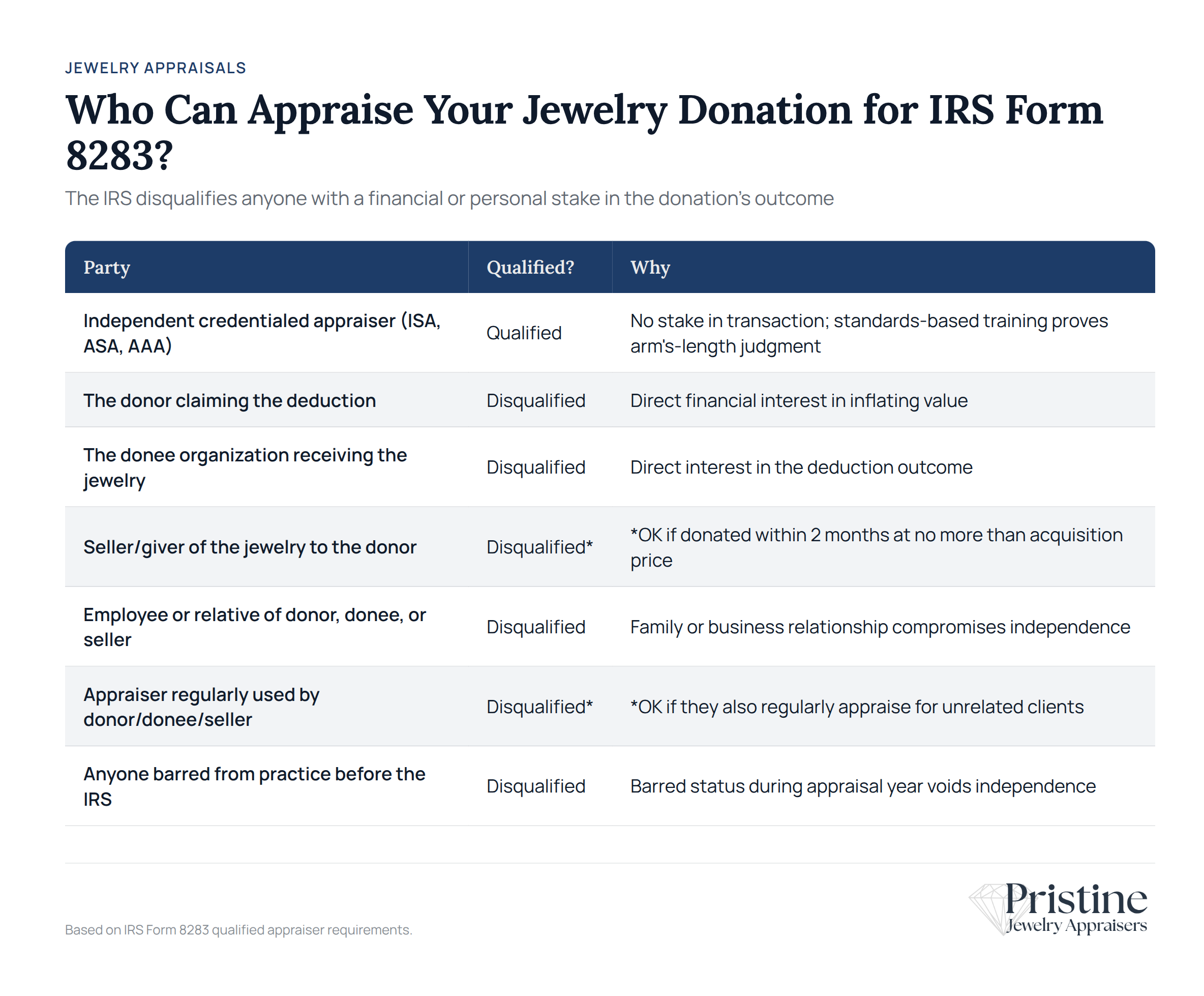
Not every credentialed appraiser can sign off on every donation. The IRS excludes several categories of people specifically because their financial or personal interest in the outcome would compromise independence. A qualified appraiser cannot be:
- The donor claiming the deduction, or the donee organization receiving the jewelry.
- The party who sold, exchanged, or gave the jewelry to the donor, unless the donor acquired the item and donated it within two months, at no more than its acquisition price.
- An employee of the donor, the donee, or the seller/party listed above, or a party related to any of them by family or business relationship.
- An appraiser regularly used by the donor, the donee, or the selling party, unless that appraiser also regularly performs appraisals for other, unrelated clients.
- Anyone barred from practice before the IRS during the year the appraisal was prepared.
These rules exist because an appraiser with a stake in the transaction, whether financial, familial, or professional, has an incentive to inflate value. Our appraisers hold credentials with organizations such as the ISA, ASA, and AAA specifically because independent, standards-based training is the credibility check the IRS is looking for when it evaluates whether an appraisal was genuinely arm's length.
Why the Appraisal Fee Can Never Be Based on Value
The fee arrangement for a qualified appraisal cannot be tied to a percentage of the jewelry's appraised value, and it cannot be structured around the size of the resulting tax deduction. A flat fee, agreed before the appraiser knows what conclusion they will reach, is the only structure that satisfies the IRS's independence standard for qualified appraisals under Publication 561.
The logic is straightforward: a percentage-based fee gives the appraiser a direct financial reason to push the number higher, which undermines the entire point of requiring an independent opinion. If a fee arrangement is contingent on what the IRS ultimately allows as a deduction after an examination, that also counts as a prohibited percentage-based fee, even if it was not labeled that way at the outset.
Our appraisers quote every jewelry donation appraisal as a fixed fee before any work begins, and the fee is unrelated to the value the appraisal ultimately concludes. For more detail on how appraisal fees are actually scoped for jewelry, our breakdown of what determines jewelry appraisal cost covers the factors that legitimately affect pricing, none of which include the item's value.
What Happens if the Appraisal Overstates Value?
A jewelry appraisal that substantially overstates fair market value exposes both the donor and the appraiser to consequences. The donor can face a disallowed deduction plus penalties for a substantial or gross valuation misstatement, calculated as a percentage of the underpaid tax attributable to the inflated value. Appraisers who knowingly prepare appraisals that lead to these misstatements can face their own separate penalty and, in serious or repeated cases, can be barred from preparing appraisals the IRS will accept going forward.
This is the real reason the independence rules and the anti-percentage-fee rule exist together. An appraiser who has no financial stake in the outcome, and who knows their professional standing is on the line for an inflated number, has every incentive to land on a defensible, well-documented figure rather than a generous one. That is the standard our team works to on every jewelry donation file, whether the deduction is a single ring appraised just over $5,000 or a multi-piece estate collection.
Key takeaway: A jewelry donation appraisal only protects your deduction if it is independent, detailed at the gemstone level, timed correctly around the contribution date, and paid for as a flat fee. Skipping any one of those requirements can put the whole deduction at risk.
If you are planning a jewelry donation and expect to claim more than $5,000, it is worth requesting an appraisal well before your filing deadline so the 60-day window and the appraiser's review both have room to work.
This article is provided for general informational purposes only and does not constitute legal, tax, or financial advice. Readers should consult a qualified attorney or CPA regarding their specific circumstances.