
Blog
Jewelry Appraisal Rules for IRS Estate and Gift Tax Returns Explained
The IRS values inherited or gifted jewelry differently than an insurance policy does, and a piece worth just $3,000 can trigger a mandatory sworn appraisal. Here is exactly what Form 706 and Form 709 require, and how to avoid the penalties tied to getting the number wrong.
When a family member passes away or transfers valuable jewelry as a gift, the IRS expects a specific kind of documentation. Not an insurance estimate, not a family guess at what grandma's ring might be worth, but a fair market value appraisal that meets a defined regulatory standard. Executors, heirs, and estate attorneys who get this wrong risk two very different problems: a return that understates value and draws scrutiny, or one that overstates value and inflates the stepped-up basis heirs later rely on. This guide walks through what the IRS actually requires when jewelry shows up on Form 706 (estate tax) or Form 709 (gift tax), and when our jewelry appraisal service becomes not just useful but necessary.
What Counts as Jewelry for Estate and Gift Tax Reporting
Jewelry for tax purposes covers finished pieces (rings, necklaces, watches, bracelets) as well as loose stones and precious metal items held as personal property. It sits inside a broader IRS category known as household and personal effects, alongside furs, silverware, and fine art. That grouping matters because the reporting rules for this category work differently than they do for cash, securities, or real estate, and jewelry in particular draws extra attention because its value is so easy to misjudge without specialized training.
Most estates hold a mix of everyday jewelry and a few standout pieces. Industry practice recommends grouping ordinary, low-value items together on the return while listing appreciable pieces, fine jewelry, signed pieces, or anything with a notable gemstone, individually with its own valuation.
The Fair Market Value Standard the IRS Requires
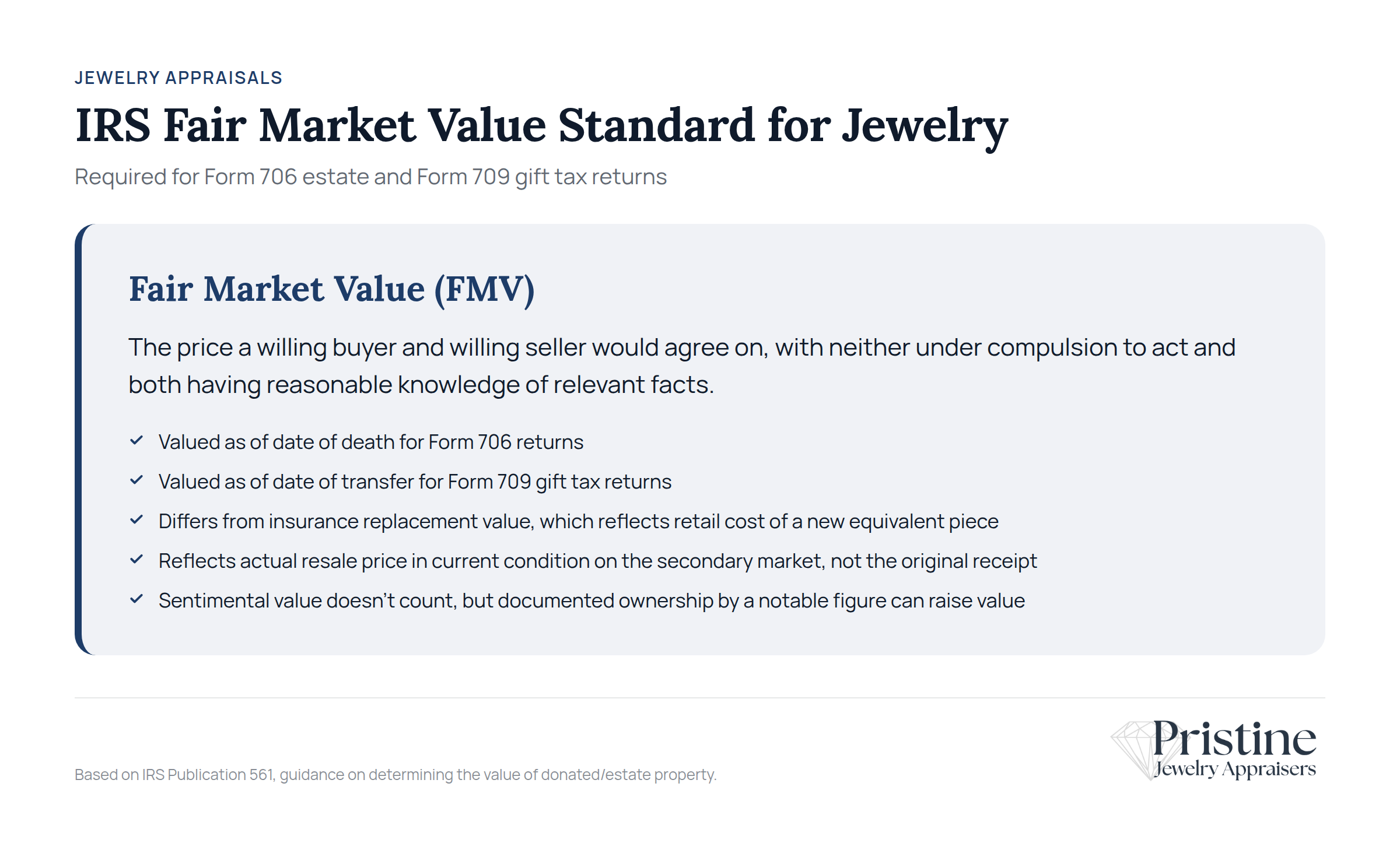
Fair market value is the price a willing buyer and willing seller would agree on, with neither under compulsion to act and both having reasonable knowledge of the relevant facts. That standard applies as of the date of death for Form 706, and as of the date of the transfer for Form 709 gift tax returns.
This is not the same number as an insurance replacement value, and it is rarely the same number as the original retail receipt. Insurance replacement value reflects what it would cost to buy an equivalent new piece at retail; fair market value reflects what the piece would actually sell for in its current condition on the relevant secondary market. Sentimental value has no bearing on the figure at all, though a documented connection to a famous or notable owner can increase it, according to the IRS's guidance on determining property value.
Example: An heir inherits a diamond engagement ring insured for $12,000. Its fair market value, the price a willing buyer would actually pay for a comparable used piece, might land closer to $5,000 to $7,000. Reporting the insurance figure instead of fair market value overstates the estate and invites questions the executor did not need to invite.
Watch out: Jewelers and pawn buyers sometimes offer a quick verbal estimate. That is not an appraisal, and it will not hold up if the return is ever reviewed.
When a Sworn Expert Appraisal Becomes Mandatory
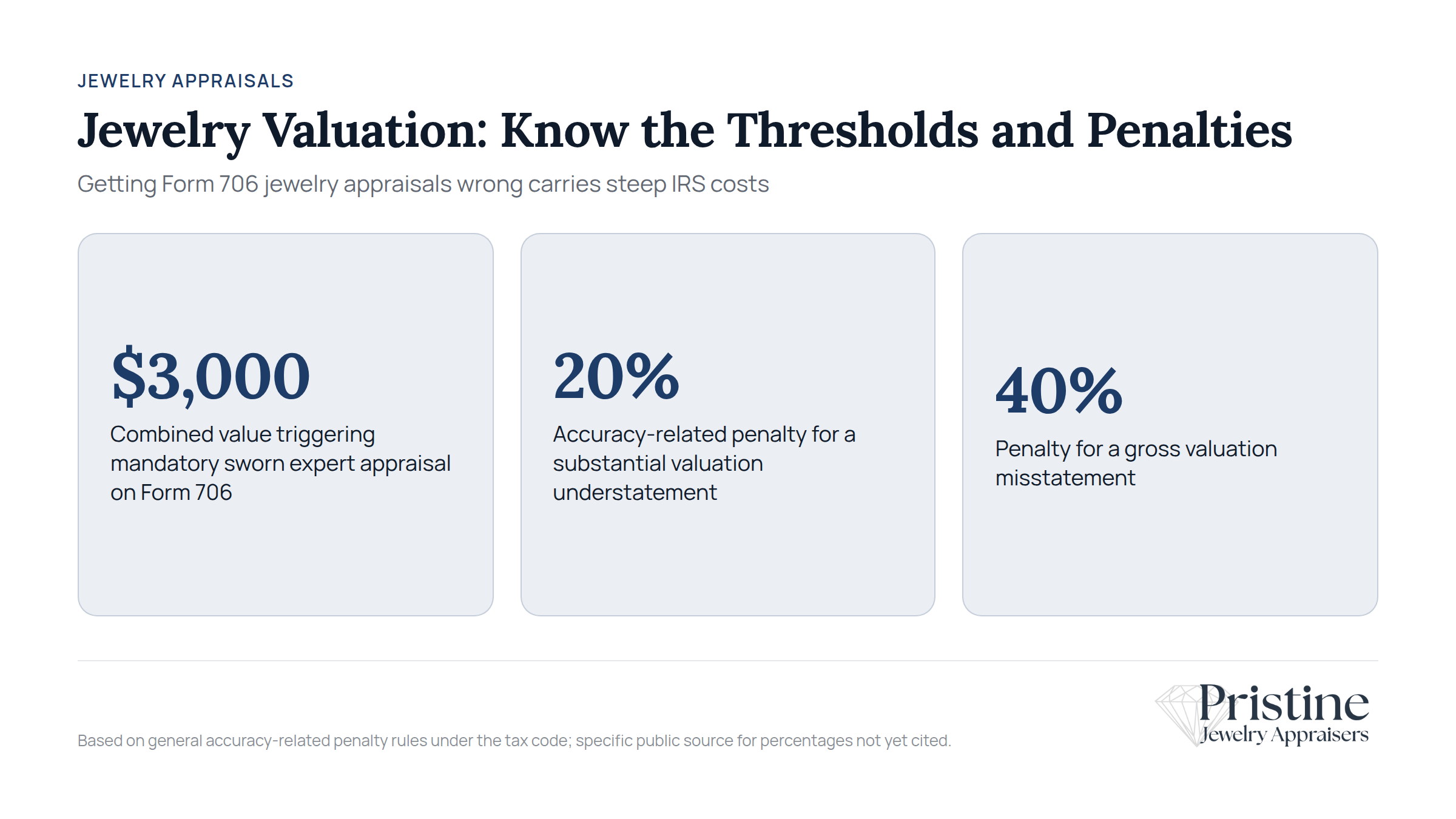
Under federal regulations governing household and personal effects, if jewelry and similarly specialized items (furs, silverware, fine art, antiques) have a combined value over $3,000, an expert appraisal filed under oath must accompany the estate tax return, according to 26 CFR 20.2031-6. That $3,000 threshold applies to the whole category of high-value personal effects together, not to a single ring or watch in isolation, so even a modest jewelry collection can cross the line once it is combined with other appreciable items.
Because jewelry appraisal requires specific gemological training, engagement fees for this kind of work are quoted as a fixed cost after we scope the piece or collection, never billed hourly. Factors like the number of items, the depth of gemstone analysis required, and whether the report needs to be IRS-qualified all affect the fee; our guide on what determines the cost of a professional jewelry appraisal breaks this down in more detail.
What a Compliant Jewelry Appraisal Report Must Include
Gems and jewelry are specialized enough that a generalist appraiser almost never has the training to value them correctly. A compliant report needs to describe the style of the piece, the cut and setting of each gem, and whether the design is currently in fashion, including whether redesigning, recutting, or resetting the stone could change its value, per IRS guidance on valuing donated and appraised property.
At minimum, a jewelry appraisal report prepared for estate or gift tax purposes should document the following:
- Stone characteristics: coloring, carat weight, cut quality, brilliance, and any flaws or inclusions
- Metal content and condition: karat weight, hallmarks, wear, and any repairs or alterations
- Grading documentation: GIA certificates or equivalent laboratory reports where available
- Visual evidence: clear, color-accurate photographs of the piece
- Market analysis: comparable sales that support the concluded fair market value
Pro tip: Keep the original grading certificate with the estate paperwork, not just with the jewelry itself. Certificates get separated from the pieces they describe more often than families expect.
Reporting Jewelry Gifts on Form 709
Gift tax valuation uses the same willing buyer, willing seller fair market value concept as estate tax, measured as of the date the gift is made rather than the date of death. Unlike the estate tax, there is no alternate valuation date option for gift tax reporting, so the appraisal date matters more precisely here.
The tax code does not set a jewelry-specific dollar threshold that automatically requires an appraisal on Form 709. Instead, the IRS looks for adequate disclosure: either a qualified appraisal from an independent appraiser or a sufficiently detailed explanation of how the value was reached. In practice, a documented appraisal is the far safer route for any jewelry gift substantial enough to use part of the donor's lifetime exemption.
The Cost of Getting the Valuation Wrong
Accuracy matters in both directions. Understating jewelry's value on Form 706 can trigger an accuracy-related penalty under the tax code: 20 percent of the underpayment for a substantial valuation understatement, rising to 40 percent for a gross valuation misstatement. Overstating the value creates a different problem: it inflates the stepped-up basis heirs rely on, and an inflated basis can unravel just as easily if the estate is ever examined.
Both risks point to the same solution: a documented, defensible fair market value appraisal prepared before the return is filed, not a guess reverse-engineered from a receipt or an insurance policy.
How We Help Executors and Heirs Document Jewelry Correctly
Our appraisers hold credentials with organizations including the ASA, ISA, AAA, GIA, and NAJA, and every jewelry appraisal we deliver is prepared in accordance with USPAP so it meets IRS documentation requirements for Forms 706 and 709. We handle the gemological detail, the comparable sales research, and the report formatting so the family or the attorney managing the estate does not have to guess at what the return requires.
If you are settling an estate, filing a gift tax return, or simply want documentation in place before either becomes necessary, you can request a jewelry appraisal and we will scope the assignment and quote a fixed fee before any work begins.
This article is provided for general informational purposes only and does not constitute legal, tax, or financial advice. Readers should consult a qualified attorney or CPA regarding their specific circumstances.